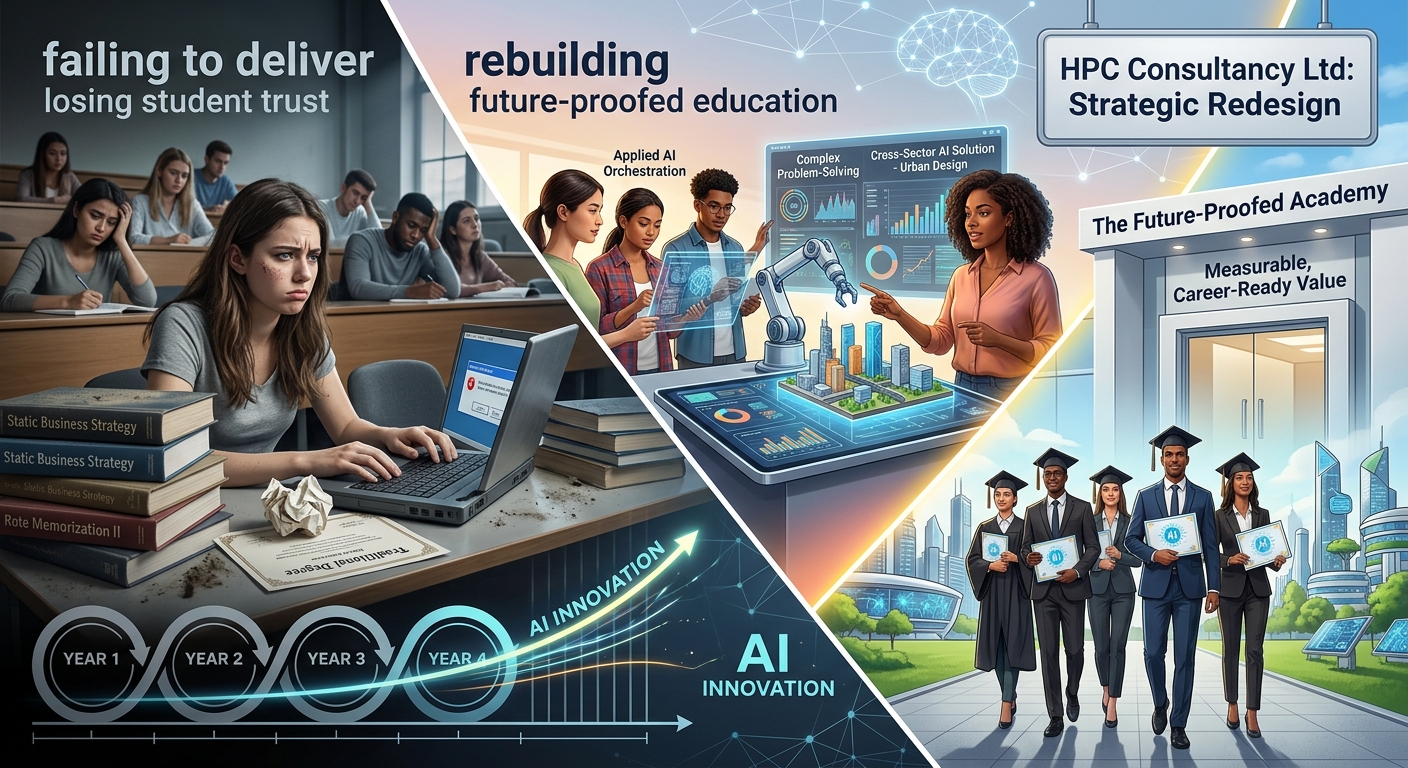
Traditional Bangladesh educational institutions are facing a critical crisis of faith. Schools, colleges, and universities are increasingly perceived as outdated systems failing to prepare students for the realities of the modern workforce. Students invest significant time and financial resources, only to discover that the knowledge they acquired is irrelevant by the time they graduate.
This disconnect has eroded trust in higher education. Academic institutions continue to rely on static syllabi and multi-year course cycles that cannot keep pace with rapid technological advancement. As a result, degrees no longer offer a clear path to career security, leading students to question the value of traditional academic paths.
AI and the Obsolescence of Traditional Subjects
The rapid emergence of generative and autonomous AI systems has fundamentally altered the skills landscape. Traditional subjects rooted in routine coding, basic data analysis, standard business strategy, or rote memorization are becoming obsolete within years, if not months.
When algorithms can process corporate data, write complex code, generate marketing campaigns, and analyze legal contracts instantly, static degrees lose their competitive edge. Teaching students what to think or memorize in a specific field is no longer effective when AI can perform those tasks faster and more accurately. Traditional static courses are no longer sufficient for modern workforce demands.
What to Study in the Age of Artificial Intelligence
To remain relevant, education must shift away from rigid subject silos and focus on dynamic, future-ready capabilities. Students and educational leaders must prioritize:
Applied AI orchestration and human-machine interaction.
Complex, cross-sector problem-solving and critical reasoning.
Strategic adaptability, continuous learning, and decision-making under uncertainty.
High-level system architecture, governance, and physical infrastructure management.
Transforming Teaching Processes and Curriculum Vision
Bringing true vision back to education requires a fundamental restructuring of teaching methods. Bangladesh Institutions must abandon passive lectures, rigid examinations, and static textbooks in favor of flexible, real-time learning ecosystems.
Curricula should be continuously updated based on real-world industry demands. Teaching processes must shift from static delivery to active, project-based environments where students solve live, multi-disciplinary problems using advanced AI frameworks.
Rebuilding Education with HPC Consultancy
Restructuring educational institutions and designing forward-looking courses requires strategic foresight and specialized guidance. HPC Consultancy Ltd works directly with Bangladesh educational providers, private equity groups, and academic leaders to redesign academic models with a clear forecast vision.
By consulting with HPC Consultancy Ltd, institutions can:
Conduct comprehensive curriculum audits to phase out redundant, legacy courses.
Design dynamic, future-proofed degree programs aligned with global AI and technological trends.
Optimize campus infrastructure and integrate modern tech-driven learning environments.
Ensure sustainable enrollment growth by delivering measurable, career-ready value to students.